
Louvre Abu Dhabi — complete visitor guide
Is the Louvre Abu Dhabi worth visiting and how much does it cost?
Adult tickets (18+) are AED 70 including VAT, and under-18s enter free. The permanent collection is genuinely strong — a cross-civilisation narrative from ancient Mesopotamia to the 20th century, housed in Jean Nouvel's iconic dome structure. Allow 2.5–3.5 hours. It is the best museum in the UAE.
The building and the collection
| At a glance | |
|---|---|
| Where | Saadiyat Island, around 15 km from central Abu Dhabi |
| Cost | Adult tickets (18+) AED 70 including VAT; free for under-18s |
| Time needed | Around 2.5–3.5 hours for the permanent collection, plus 20–30 minutes for the boardwalk |
| Getting there | Taxi/rideshare (around 20–30 min, AED 40–60 from central Abu Dhabi) or self-drive with free parking |
| Best time | Late morning, November–March, to catch the “rain of light” and a comfortable boardwalk walk |
The Louvre Abu Dhabi is not a branch of the Paris Louvre — it is a separate institution that has a 30-year agreement (signed in 2007) to use the Louvre name and to borrow works from French national museums. The Abu Dhabi government paid France approximately €1 billion for that agreement, making it one of the largest cultural diplomacy transactions in modern history. The physical building is the work of French architect Jean Nouvel and sits on a pier over the Saadiyat Island waterfront.
The dome — 180 metres in diameter, made from a double-layer lattice — is the iconic image. Photographs do not adequately convey the experience of standing beneath it while light moves through the structure. This alone is worth the visit. But the collection beneath it is what makes the Louvre Abu Dhabi the most serious cultural institution in the UAE, not just the most photogenic one.
Jean Nouvel’s design: how the dome works
Jean Nouvel won the commission in 2007 after a design competition and spent the better part of a decade refining the building before it opened in November 2017. His central concept was a large sheltering dome — a reference to the domes of Islamic architecture and to the canopy of a palm grove, where filtered light creates shifting shadow patterns on the ground. He wanted the dome to be simultaneously recognisable as a landmark from the sea and to dissolve into the landscape when you were beneath it.
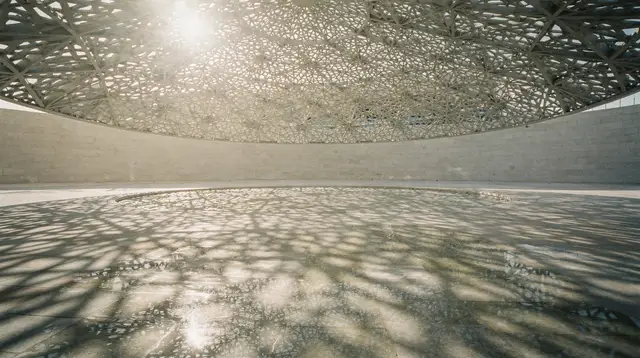
The dome is 180 metres in diameter and weighs approximately 7,500 tonnes. It is composed of 7,850 unique star shapes arranged in eight layers of interlocking stainless steel. The star shapes derive from geometric patterns common in Islamic architecture — specifically the four-pointed, eight-pointed, and sixteen-pointed star sequences found in Mamluk, Moroccan, and Andalusian tilework. No two star-shaped openings in the entire dome are identical, because the geometry required for a curved dome structure means each position demands a slightly different calculation. The engineering firm involved in resolving those calculations worked with Nouvel for several years before the structure could be fabricated.
The dome floats 40 metres above the ground at its highest point, supported by a relatively slender ring structure. From below, on a clear day, sunlight passes through all eight layers at slightly different angles, creating what is described as the “rain of light” effect: thousands of individual light points dance across the water between the museum pavilions, on the boardwalk, and on the white surfaces of the galleries below. The effect changes hour by hour as the sun moves, and is most dramatic in the two hours around midday in winter (November to March), when the sun is high enough to produce maximum penetration through the lattice layers without being directly overhead.
The Gulf heat presented a serious engineering challenge. The dome needs to shelter the museum campus from direct solar radiation while still allowing the light effect to function. The eight-layer design diffuses direct sunlight into indirect ambient light before it reaches inhabited spaces, reducing solar gain significantly. The pavilions beneath the dome are further climate-controlled, but the covered outdoor spaces between the galleries — the boardwalks and water channels — are passable even in summer (with some discomfort) because the dome reduces the thermal load.
The museum buildings themselves are a series of white cubic pavilions arranged across a pier that extends into the water. Some pavilions are connected by covered walkways, others by open bridges. The overall arrangement creates a labyrinthine quality — deliberately so. Nouvel wanted the approach to the individual galleries to feel like moving through a medina, a sequence of streets and courtyards rather than a single monolithic building.
The financial arrangement between France and Abu Dhabi
The 2007 intergovernmental agreement between France and Abu Dhabi involves several components beyond the name license. Abu Dhabi agreed to pay France approximately €400 million for the right to use the Louvre name over 30 years, approximately €190 million for art loans and curatorial expertise, and approximately €165 million for temporary exhibitions. The remaining amounts in the reported €1 billion total cover management advice, scientific expertise, and training programs for Abu Dhabi museum professionals.
In exchange, France agreed to loan major works from the Louvre Paris, the Musée d’Orsay, the Centre Pompidou, the Musée du Quai Branly, Versailles, and approximately a dozen other French national museums. These loans rotate — individual works typically stay in Abu Dhabi for between six months and three years before returning to France. The Abu Dhabi institution acquires its own works simultaneously, and the long-term intention is that the Abu Dhabi permanent collection will eventually be large enough to sustain the museum without heavy reliance on French loans.
The agreement was politically contentious in France when it was announced. Critics argued that France was effectively renting out national cultural patrimony for commercial gain. The French government’s position was that the agreement funded French cultural institutions during a period of significant budget pressure and extended French cultural influence into a strategically important region. The debate has largely subsided — the museum has been well-received critically and the quality of its execution has been difficult to argue with.
For Abu Dhabi, the logic was about soft power and legitimacy. The Abu Dhabi Tourism and Culture Authority was simultaneously launching Saadiyat Island as a cultural district, and the Louvre name gave the project immediate international recognition that no locally-developed institution could have generated in the same timeframe. Similar logic explains the Guggenheim Abu Dhabi (still in planning, see below) and the Zayed National Museum.
Compared to other international museum satellite projects, the Louvre Abu Dhabi has been the most successful. The Guggenheim Bilbao (1997) is the closest predecessor — it galvanised the regeneration of Bilbao and generated international tourism to a previously overlooked city. The Louvre Abu Dhabi has done something similar for Saadiyat Island, though the Abu Dhabi government was starting from a higher economic base. The Hermitage Amsterdam satellite closed in 2022, partly due to COVID disruptions and partly due to complications following the Ukraine war. The Abu Dhabi model — with a 30-year agreement, a purpose-built building, and government backing at the highest level — appears more durable.
The permanent collection: all 12 galleries in detail
The collection is divided into 12 galleries that present a cross-civilisation, cross-religion narrative. The curatorial argument — developed jointly by the Louvre Abu Dhabi’s in-house team and French museum experts — is that human cultures across time asked the same fundamental questions and produced recognisably parallel answers, independently. Galleries move thematically rather than by civilisation or chronology, juxtaposing objects from different cultures that address the same theme.
Gallery 1 — The First Villages: the Neolithic period and the emergence of settled communities across the globe. The gallery opens with objects from the Arabian Peninsula itself — flint tools from Abu Dhabi emirate, pottery from the Umm al-Nar culture (2500 BCE), and obsidian trade goods that show the Gulf coast connected to wider Indian Ocean networks from very early dates. Alongside these: Neolithic figurines from Anatolia (Turkey), early pottery from sub-Saharan Africa, and bone tools from East Asia. The display makes a clear argument that sedentary life and the production of objects with aesthetic as well as functional value emerged across the world independently and roughly simultaneously.
Gallery 2 — The First Great Powers: Bronze Age civilisations from the Aegean, the Nile, Mesopotamia, the Indus Valley, and China. The centrepiece of this gallery is a Bactrian princess figurine — a composite figure from Central Asia (modern Afghanistan/Turkmenistan) dating to approximately 2500–2000 BCE, made from chlorite and alabaster.
These figures were produced in the hundreds across a trade network stretching from the Persian Gulf to the Indus Valley, but the example here is among the finest known. Nearby: a statue of an Egyptian scribe in grey granite, cuneiform tablets recording grain transactions from Sumerian Ur, and a bronze vessel from Shang Dynasty China. The density of genuine museum-quality objects in this room is higher than many European archaeological departments can manage.
Gallery 3 — Ancient Religions and Trades: the emergence of organised religion and its relationship to trade networks. The gallery covers the Bronze Age Mediterranean and Middle East — Egyptian funerary objects alongside Syrian ivories, Canaanite gold jewelry alongside Mycenaean pottery. There is a Phoenician ivory panel here that illustrates the interconnectedness of the ancient Mediterranean trade world with extraordinary clarity: the material came from Africa, the motifs are Egyptian, the craftsmen were Levantine, and the finished object was found in a palace in northern Syria.
Gallery 4 — Universal Religions: the pivotal centuries between roughly 200 BCE and 800 CE, during which Buddhism, Christianity, Islam, and Hinduism emerged or consolidated as universal religions. This gallery is the most explicitly comparative in the museum — a Buddhist stupa fragment from Gandhara (Pakistan) near a Roman sarcophagus near an early Quran page near a Hindu bronze. The curation is delicate; the wall text is careful to treat all four traditions with equal analytic distance rather than privileging any.
Gallery 5 — From Sultanates to Empires: the medieval period globally, roughly 800–1500 CE. Persian manuscripts with miniature paintings, Chinese Song Dynasty celadon ceramics, Byzantine gold enamel icons, sub-Saharan African carved ivories from the Kingdom of Benin, and illuminated European manuscripts in the same cases. The Islamic geometric carpet and the Flemish tapestry side by side in this gallery make a comparison the objects’ original owners would never have recognised. Both are products of textile traditions that reached extraordinary technical refinement in the same centuries; neither tradition knew the other existed.
Gallery 6 — A Connected World: the 15th and 16th centuries, when the maritime empires of Portugal, Spain, and the Ottoman Empire began connecting previously isolated cultural zones. Maps, globes, navigational instruments, and trade goods dominate. An Ottoman astrolabe made in Constantinople; a Portuguese azulejo tile panel from Lisbon; a Chinese blue-and-white porcelain jar that was copied from an Islamic design that was itself adapted from a Chinese prototype — the feedback loop of intercultural borrowing is made visible in a single display case.
Gallery 7 — The East–West Question: the 17th century, the peak of the European interest in the “Orient” and the simultaneous Islamic courts’ interest in European art and objects. European chinoiserie objects next to Chinese objects made for export to Europe next to Ottoman court portraits in a style borrowed from Venetian painting. This is the gallery where the curation’s thesis becomes most conceptually interesting — and most debatable. The wall text is careful not to frame the exchange as simply one-directional.
Gallery 8 — The Triumph of Light: the European Baroque and the parallel flowering of Mughal painting, Safavid carpets, and Japanese screen painting in the 17th century. The room contains some of the most visually spectacular objects in the museum. A Mughal jade cup carved for the Emperor Shah Jahan (who built the Taj Mahal) sits near a Dutch Golden Age painting near a Japanese lacquerwork cabinet. The quality of the objects in this gallery is as high as anything you will find in a European major-collections museum.
Gallery 9 — A New Art for New Worlds: the 18th century, the age of Enlightenment in Europe, and its global contemporaries. European portraiture and landscape painting alongside Indian Company School works (Indian artists painting for British patrons), Chinese export porcelain, and African Dahomey bronzes. The cross-civilisation thesis feels most strained in this gallery — the objects are excellent but the connections between them require more intellectual effort than in earlier rooms.
Gallery 10 — Modernities: the 19th century, the era of industrialisation, nationalism, and the emergence of modern art movements in Europe alongside the colonial encounter with non-Western traditions. European academic paintings, Japanese woodblock prints (which directly influenced Impressionism), and early documentary photography from the Middle East and North Africa. The inclusion of North African and Middle Eastern photographs from this period — many of which are in French collections and rarely exhibited — is notable.
Gallery 11 — Challenging Modernity: early 20th-century art from multiple traditions. European avant-garde works (Cubist and abstract paintings), African masks and sculptures from traditions that directly influenced Picasso and Braque, and Islamic calligraphic art from the same period. The gallery makes a case — reasonably well — that the 20th-century European art revolution was partly catalysed by its encounter with non-Western forms, not solely by internal European logic.
Gallery 12 — A Global Stage: the mid-to-late 20th century. The room that most visitors will find familiar in terms of artist names. Long-term loans from French national collections have included works by Fernand Léger, René Magritte, and Yves Klein. The Abu Dhabi permanent collection in the modern period includes works by Arab, Asian, and African artists rarely seen in European or American museums. This gallery is the least fixed in its content — loan rotations and new acquisitions mean it changes more frequently than the ancient galleries.
The permanent collection highlights: specific works
The Louvre Abu Dhabi has acquired its own permanent works gradually since 2017. Among the notable acquisitions:
A 5,000-year-old Bactrian composite figure (the “Bactrian Princess”) in chlorite and alabaster — arguably the single most significant object in the permanent collection and one of the finest examples of its type anywhere. A large Egyptian painted wood and linen burial mask from around 1000 BCE. A Roman mosaic floor panel from the 2nd century CE. A page from an early Quran in Kufic script, dated to approximately the 8th century. A monumental 17th-century Ottoman carpet from Anatolia measuring roughly 6 by 9 metres.
Long-term loan works have included Leonardo da Vinci’s “La Belle Ferronnière” — one of only four portraits by Leonardo in existence — and Édouard Manet’s “Le Déjeuner sur l’herbe,” the painting that caused a scandal at the Paris Salon des Refusés in 1863. The loan rotations mean specific famous works are not always on display. Check the museum website before visiting if there is a specific work you want to see.
Temporary exhibitions
Since opening in 2017, the Louvre Abu Dhabi has hosted a sequence of major temporary exhibitions that have generally maintained high curatorial standards. Past shows have included “Rembrandt, Vermeer and the Dutch Golden Age” (loans from the Louvre Paris and the Rijksmuseum); “Birth of a Capital — Abu Dhabi 1966–1971” (a documentary exhibition about the early years of the modern emirate); “Furusiyya: The Art of Chivalry between East and West” (Islamic and European martial arts objects and manuscripts); and “Connected Histories: India and the World” (Indian Ocean trade from antiquity to the 20th century).
Temporary exhibitions sometimes have their own admission charge on top of the general ticket and sometimes are included in general admission. The website specifies the current arrangement. Not all temporary shows are equal in quality — the ones partnered with major French or international institutions tend to be stronger than the locally developed thematic shows.
The outdoor boardwalk and waterfront experience
Most visitors go directly from the entrance to the galleries and miss the outdoor spaces, which is a significant loss. The museum is built on a peninsula extending into the Saadiyat Island waterfront, and the boardwalk circuit around the dome’s perimeter is a distinct experience from the interior.
From sea level, the dome’s scale becomes apparent in a way that interior views do not convey. The dome edge is approximately 23 metres above the water at its lowest point; the curve overhead creates a sense of shelter that feels both architectural and almost geological — like being in a shallow cave with a ceiling of light. The “rain of light” effect, most often photographed from inside, is equally striking from the waterfront when the angle is right (mid-morning to midday).
The boardwalk is exposed to the Gulf sun for much of its circuit. In summer (June to September), it is uncomfortable to walk the full perimeter between 10am and 5pm. In winter (November to March), it is one of the more pleasant waterfront walks in the UAE. Allow 20–30 minutes for the full outdoor circuit if conditions allow.
The views from the boardwalk take in the Saadiyat Island coastline, the Abu Dhabi city skyline in the distance, and — depending on the time of day — the late-afternoon light across the Gulf that is genuinely beautiful. Several photographic compositions of the dome are only achievable from the waterfront.
Fouquet’s Abu Dhabi: the museum restaurant in detail
Fouquet’s Abu Dhabi is the flagship restaurant inside the museum, operated by the Paris brasserie Fouquet’s (which has been on the Champs-Élysées since 1899). The Abu Dhabi outpost opened alongside the museum in 2017 and occupies a dedicated pavilion at the water’s edge with views of the dome from its terrace.
The menu is French brasserie with a UAE adaptation: expect French classics (steak tartare, croque monsieur, moules marinières) with some locally adapted dishes. Pricing is at the higher end: mains are typically AED 120–220 (€30–55), starters AED 60–90, and a full lunch for two without wine runs approximately AED 400–600 (€100–150). Service is professional and the setting is genuinely attractive.
The honest assessment is that Fouquet’s charges a significant premium for the location and brand name, and the food — while competent — does not match what you can get for similar prices at the better restaurants in the broader Abu Dhabi hotel scene. If you want to eat inside the museum and the setting matters to you, it is perfectly acceptable. If you are focused on value, the terrace café near the museum entrance (AED 30–60 for a light meal) or a taxi to the Saadiyat Beach Club restaurants (10–15 minutes) offers better value per dirham.
Wine is served at Fouquet’s (the Louvre Abu Dhabi is not a religious institution and does not apply alcohol restrictions beyond what the law requires, which means alcohol is served in licensed premises within the building). This makes Fouquet’s one of the relatively few cultural-site restaurants in Abu Dhabi where wine is available.
The museum shop
The museum shop is positioned at the exit of the main gallery circuit and is larger and better curated than most museum shops in the region. It stocks exhibition catalogues in English, French, and Arabic (typically AED 120–250 for major show catalogues, which are genuinely good reference publications), smaller books on Islamic art, Emirati cultural history, and Jean Nouvel’s architecture. Postcards and prints of works in the collection are available (AED 10–25). There is also a range of designed objects — geometric-pattern ceramics, textiles, and stationery drawing on the museum’s visual vocabulary — at prices from AED 40 to AED 400+.
For visitors interested in taking home something substantive rather than a souvenir, the exhibition catalogues and the books on Islamic geometric design are the best purchases. The Jean Nouvel architectural monograph stocked here is the definitive printed study of the dome design.
The children’s museum space
Tucked into the lower level of the museum, near the entrance, is a dedicated children’s museum called the Kids’ Museum. This is a free additional space for children under approximately age 10 (some activities have minimum age requirements). It contains hands-on activities themed around the museum’s collection — creating geometric star patterns like those in the dome, handling replica objects from different ancient civilisations, and drawing activities. It is staffed, and the activities rotate.
The Kids’ Museum is not prominent in the museum’s signage and many visitors with children miss it entirely. It is worth 45–60 minutes for children aged 4–8 and turns a standard museum visit into something more engaging for very young visitors who would struggle with the main galleries.
With children under 18 free, a family of two adults pays AED 140 in total. It is arguably one of the highest-value cultural activities in the UAE for families with older children (10–16) who have some capacity for engagement with historical objects.
Annual free entry days
The Louvre Abu Dhabi offers free general admission on specific days each year:
- UAE National Day (2 December): free entry for all visitors
- International Museum Day (18 May): free entry
- The museum’s anniversary (November): free or heavily discounted entry in the week around the anniversary
On these days, visitor numbers are significantly higher than normal. The free days attract both tourists and UAE residents who might not otherwise pay the admission. If your visit falls on a free day, arrive at opening to avoid the midday crowds — the museum becomes substantially busier by 11am.
Visiting with a tour guide: what a guide adds
General admission does not include a guided tour. The audio guide (see the official website for current price) provides commentary on approximately 60 selected works. A live guide — either pre-booked through the museum or through a private operator — adds considerably more.
What a good guide adds: context for the cross-civilisation thesis that the labels do not fully explain (why two objects from different cultures are side by side, what the curators intended), background on specific acquisition stories (some of the permanent collection works have interesting provenance), and answers to questions that labels cannot anticipate. In the ancient galleries (Rooms 1–4), a guide who can read cuneiform or hieroglyphs provides demonstrations that few visitors have ever experienced.
Private tours of the Louvre Abu Dhabi run approximately AED 300–600 for a 2-hour guided visit (excluding admission). Group tours offered by Abu Dhabi tour operators cost less per person. If you have a genuine interest in the collection rather than just the building, the investment in a guide for the permanent collection is worth considering.
The museum’s role in soft power and cultural diplomacy
The Louvre Abu Dhabi is the most visible element of Abu Dhabi’s strategy to reposition itself internationally as a cultural capital rather than purely a financial and oil capital. Abu Dhabi’s Tourism and Culture Authority (now the Department of Culture and Tourism) has invested heavily in this strategy since the mid-2000s, with the Saadiyat Cultural District as its central project.
The Louvre gives Abu Dhabi access to the most recognised museum brand in the world. The Guggenheim Abu Dhabi (when it opens, discussed below) will add a second international anchor. The Zayed National Museum provides the national narrative that contextualises both. Together, these three institutions are designed to make Saadiyat Island into an internationally credible museum district — not just within the Gulf, but in the global tier of cultural destinations.
This logic — using cultural institutions as instruments of international recognition — is well-established in the museum world. The Guggenheim Bilbao (1997) demonstrated the model: an architecturally iconic building by a famous architect, housing a world-class collection, can transform the international perception of a city within a few years.
Abu Dhabi’s Louvre has achieved something similar, though it is worth noting that the longer-term test of these institutions is whether they develop genuine academic and curatorial authority, not just impressive buildings. The Louvre Abu Dhabi has made reasonable progress on this — its acquisition program is serious, its curatorial appointments have been well-regarded in the international museum community, and its temporary exhibitions have attracted genuine international loans.
The Saadiyat Cultural District master plan and future museums
Saadiyat Island’s Cultural District was master-planned in the early 2000s as a cluster of major international cultural institutions. The current status of each:
Louvre Abu Dhabi (open since 2017): the functioning anchor of the district. The building that defines the district’s international profile.
Zayed National Museum (partial opening as of mid-2026): Norman Foster’s five-tower building dedicated to UAE history and Sheikh Zayed’s legacy. See the dedicated Zayed National Museum guide for current status.
Guggenheim Abu Dhabi: designed by Frank Gehry (the architect of the Guggenheim Bilbao). Construction has been delayed multiple times since the original announcement in 2006. As of mid-2026, the Guggenheim Abu Dhabi is still under construction. When open, it will focus on contemporary and modern art from the Arab world, Asia, and Africa — a distinct mandate from the Louvre Abu Dhabi’s universal history focus.
Abrahamic Family House (open since 2022): a mosque, church, and synagogue on a shared campus, designed by Sir David Adjaye. This is the easiest to combine with a Louvre visit — it is 2 kilometres away. See the guide.
The full Cultural District vision has been on a longer timeline than originally announced. The original plan envisioned all four institutions opening by approximately 2012–2015. The Louvre opened in 2017, the Abrahamic Family House in 2022, the Zayed National Museum is in partial opening in 2026, and the Guggenheim has yet to open. The pace has been slow but the commitment appears genuine — the buildings are under construction and the government backing has not wavered.
Seasonal visitor patterns and best months
The Louvre Abu Dhabi is open year-round, but the experience differs significantly by season.
November to March (high season, 25–32°C): the best months to visit. The outdoor boardwalk is comfortable. You can walk between the Louvre and the Abrahamic Family House along the waterfront without suffering. The museum gardens (a series of planted areas between pavilions) are pleasant. International tourist numbers are highest in December–January, particularly around New Year and the Abu Dhabi Grand Prix (late November). Expect busier galleries on weekends.
April and October (shoulder): comfortable enough. Daytime temperatures in the mid-30s are manageable if you are not walking long distances. The outdoor spaces are usable in the morning and evening.
May to September (summer): extreme heat (40–50°C in July and August). The outdoor boardwalk is a genuine endurance test between 10am and 6pm. The museum interior is fully air-conditioned and perfectly comfortable. Visitor numbers are significantly lower — the galleries are quieter, weekend crowds are smaller. If you are visiting Abu Dhabi in summer and want to see the Louvre, go at opening (10am) or after 5pm. The indoor experience is identical to winter; only the outdoor sections suffer.
Practical tips on navigating the 12 galleries efficiently
The 12 galleries run in a roughly sequential path from the entrance, but the building’s labyrinthine structure means it is possible to loop back, skip ahead, or miss sections without obvious signage. A few tips for efficient navigation:
Pick up the physical floor plan at the entrance — it is a leaflet, free, and more useful than the app for orienting in the moment. The galleries are numbered 1–12 and follow a logical sequence, but the connections between them are not always intuitive.
The most visited sections (Gallery 2 with the Bactrian Princess, Gallery 12 with the major loans, Gallery 8 with the Mughal and Dutch objects) will have the most visitors mid-morning. If any of these rooms interest you specifically, aim for them at opening (10am–11am) or in the late afternoon (after 5pm).
The boardwalk between pavilions is part of the visitor circuit. On hot days, staff will direct you through covered internal connections. In cooler months, the open boardwalk transitions between galleries are one of the building’s pleasures.
Allow yourself to be distracted by objects that are not famous. The Louvre Abu Dhabi’s institutional advantage over the Paris Louvre is that its selection is curated tightly enough that nearly every object in the building is worth looking at. Unlike Paris, where you can walk through rooms of significant objects without stopping because there are simply too many, in Abu Dhabi the density is right for attentive engagement.
What most visitors miss
Several elements of the Louvre Abu Dhabi are consistently overlooked:
The waterfront boardwalk circuit: as noted above, most visitors go directly to the galleries. The full outdoor circuit around the dome takes 20–30 minutes and gives you a completely different spatial reading of the building.
Gallery 4 (Universal Religions): visitor flow tends to thin out in the middle galleries while concentrating at Gallery 2 (ancient objects) and Gallery 12 (famous modern loans). Gallery 4 is one of the most carefully curated rooms in the museum and is often nearly empty.
The Kids’ Museum: families with children under 10 consistently miss this. See the section above.
The upper terrace views: a small outdoor terrace at the upper level of one pavilion offers views across the dome from above — a perspective that almost no visitor photographs show. Ask staff at the information desk for its current accessibility.
The courtyard water channels: between the pavilions, several of the water channels that separate the museum buildings from each other are low enough that you walk at water level. The effect of being at water level with the dome overhead is the most dramatic spatial experience the building offers, and it is fully outside the ticketed galleries — accessible on the approach and the boardwalk.
Practical admission details
Adult tickets (18+): AED 70 including VAT. Free entry for under-18s, UAE-national and resident seniors aged 60+, members with one guest, ICOM/ICOMOS holders, journalists, and People of Determination with a companion. For other reduced rates and annual passes, see the official website (louvreabudhabi.ae).
Temporary exhibitions are sometimes included in general admission, sometimes charged separately. The website lists current temporary shows and their ticketing structure.
Online booking is available and recommended for weekends. Thursday–Saturday evenings and Friday mornings are the busiest times. The ticket queue in person is rarely more than 10–15 minutes even on busy days.
Opening hours
Galleries and exhibitions: Monday to Thursday 10:00 am to 6:30 pm, Friday to Sunday 10:00 am to 8:30 pm. Last entry is 30 minutes before the galleries close. The dome area stays open until midnight (last entry 11:00 pm). Occasional late-night openings for special events — check the website for current listings.
During Ramadan, hours shift. On UAE National Day (2 December), entry is free and hours may extend. On Eid al-Fitr and Eid al-Adha, the museum may close entirely or operate on reduced hours. If your visit falls on or near an Islamic holiday, verify before booking transport.
Getting there
Louvre Abu Dhabi is on Saadiyat Island, approximately 15 kilometres from the centre of Abu Dhabi city.
By taxi or rideshare: the most practical option. From Abu Dhabi city centre (Corniche area), approximately 20–30 minutes, AED 40–60. Taxis and Careem/Uber are available at the exit for the return journey.
By bus: the Saadiyat Cultural District shuttle connects to Abu Dhabi mainland. Check the Abu Dhabi Department of Culture and Tourism website for the current shuttle schedule — service frequency varies.
From Dubai: approximately 1.5–2 hours by road (160 km via E11). Many visitors combine a Louvre visit with the Grand Mosque on the same day from Dubai. Parking at the Louvre is free and ample.
From the Abrahamic Family House: 2 kilometres by taxi (AED 15–20) or a 20-minute waterfront walk. See the Abrahamic Family House guide for the Saadiyat pairing.
How long to allow
2.5 to 3.5 hours covers the permanent collection at a comfortable, reading pace. 90 minutes is enough to see the major highlights quickly but feels rushed in a space that rewards slow looking. If there is a temporary exhibition included, add 45–60 minutes. The full outdoor boardwalk circuit adds another 20–30 minutes in favourable weather.
The rain of light beneath the dome changes character over the course of the day — if you can, arrive late morning and spend some time on the boardwalk outside before entering.
What to skip and honest warnings
The audio guide: decent but not outstanding. The written labels throughout the galleries are thorough and well-translated. Skip the audio guide if you read signage carefully; rent it if you prefer to listen while looking.
The museum restaurant for budget visitors: Fouquet’s Abu Dhabi is expensive relative to value — full details in the Fouquet’s section above. The terrace café near the entrance is significantly cheaper and has good views.
Summer midday boardwalk: the approach across open water is genuinely uncomfortable in June to September midday heat. Arrive at opening (10am) or after 5pm. The museum interior is air-conditioned throughout.
All temporary exhibitions by default: the permanent collection is the reason to come. Temporary shows vary widely in quality. Read current reviews before adding a temporary show ticket.
GetYourGuideLouvre Abu Dhabi Join an Express Guided TourCheck availability → GetYourGuideAbu Dhabi: City Tour with Louvre Museum PrivateCheck availability →Combining with Saadiyat Island
Saadiyat Island’s Cultural District is an ongoing museum cluster. Currently open and worth combining:
- Abrahamic Family House: 2 km away — a free 1.5–2 hour addition to any Louvre visit; see the guide
- Zayed National Museum: in partial opening as of mid-2026 on Saadiyat — see current status in the Zayed National Museum guide
- teamLab Phenomena: also on the Saadiyat Cultural District waterfront — digital art installation, best visited on a separate day from the Louvre to avoid fatigue; see the teamLab guide
- Saadiyat Beach: 10–15 minutes from the museum by taxi; a natural afternoon extension after a morning at the Louvre — see Saadiyat Beach
For a full Saadiyat day plan, the 3-day Abu Dhabi itinerary covers the island in detail on day 2.
The Saadiyat Island destination guide covers the broader island including accommodation and restaurants.
Is the Louvre Abu Dhabi worth it?
The short answer: yes, for most visitors. AED 70 buys access to one of the most architecturally striking museum buildings in the world and a genuinely serious permanent collection. The curation is intelligent and the thesis — that human civilisations share more than they differ — is executed without being preachy. The space is not just a prestige project: it functions as a museum should.
For visitors doing Abu Dhabi on a budget: the Louvre is the one paid cultural admission that is difficult to justify skipping if you have any interest in art, history, or architecture.
For visitors comparing Abu Dhabi and Dubai cultural offerings: the Louvre Abu Dhabi is the strongest argument for Abu Dhabi as a cultural destination. See Abu Dhabi vs Dubai for a fuller comparison.
Combining with a wider Abu Dhabi trip
For visitors building a longer stay, the Louvre works well as an anchor for a Saadiyat-focused day, but it can also be the cultural counterweight to a more nature- or desert-focused trip. Travellers who spend a day at Jebel Hafeet or venture out to Liwa and the Empty Quarter often find the contrast with a morning at the Louvre — air-conditioned, curated, indoor — a welcome change of pace partway through a trip. The 4-day Abu Dhabi itinerary is a reasonable structure for combining a Saadiyat cultural day with at least one day outside the city.
Top-rated tours & activities
Hand-picked tours and activities from GetYourGuide and Viator. Book through these links and we earn a small commission at no extra cost to you.
GetYourGuide does not provide product photos: on its activity cards, the picture illustrates the type of experience and is not the operator's own photo.
Frequently asked questions about Louvre Abu Dhabi
Is Louvre Abu Dhabi a real Louvre or a franchise?
It is a separate institution with a licensing and loan agreement with the French state museums (Louvre Paris, Musée d’Orsay, Pompidou, Versailles, and others). The Abu Dhabi government paid France approximately €1 billion for a 30-year agreement covering the name, expertise in collection management, and rotating loan of major works. It is governed by the Abu Dhabi Department of Culture and Tourism, not by the French state. Think of it as a distinct museum with a substantial French partnership — not a branch and not a franchise.
What is the “rain of light” that everyone photographs?
The dome — 180 metres in diameter — is made from 7,850 unique geometric star shapes arranged in eight layers of stainless steel. Sunlight passes through the gaps in the lattice and is diffused as it filters down to the water and walkways below, creating a shifting dappled light effect. The geometry of the star shapes references the palm-leaf shadow patterns used in traditional Arab architecture and the geometric tilework of Islamic mosques. The effect changes throughout the day as the sun moves and is best seen from the outdoor boardwalk rather than the interior galleries.
Can I visit both the Louvre Abu Dhabi and the Grand Mosque in one day?
Yes, and many visitors do. A workable sequence: Louvre Abu Dhabi at opening (10:00 am, 3–4 hours), lunch on Saadiyat, taxi to Abu Dhabi city (30 minutes), Grand Mosque in the late afternoon to evening. The reverse order is also possible but check mosque closing times. The 2-day Abu Dhabi itinerary splits them across two days to avoid rushing either.
Are there works by famous artists on permanent display?
The permanent collection focuses primarily on pre-20th-century works with a cross-cultural thematic emphasis, so individual famous names are less foregrounded than the thematic display. Major loan works — including pieces by Leonardo da Vinci, Manet, and others — rotate on loan agreements. Do not plan a visit around a specific famous work without confirming it is currently on display on the museum website.
Is Louvre Abu Dhabi suitable for children?
Yes. The museum has a dedicated children’s museum space (the Kids’ Museum) for children under approximately 10, separate from the main galleries. The main galleries work well for children aged 10 and above who have some capacity for historical objects — the variety of ancient sculptures, Persian miniatures, African masks, and Chinese bronzes holds attention better than a purely European art museum. Free entry for under-18s makes it affordable.
How does it compare to the main Louvre in Paris?
The Paris Louvre has approximately 35,000 works on display from a total holding of nearly 500,000. The Abu Dhabi Louvre has around 600 permanent works plus loans. Paris is incomparably larger. The Abu Dhabi Louvre’s advantage is curation: its smaller, carefully selected collection with a coherent cross-civilisation thesis is easier to engage with in a single visit. In Paris, covering the collection fully is impossible; you navigate by selective focus. In Abu Dhabi, you can see everything in a morning and come away with a coherent sense of what the museum was trying to say.
Top-rated tours & activities
Hand-picked tours and activities from GetYourGuide and Viator. Book through these links and we earn a small commission at no extra cost to you.
GetYourGuide does not provide product photos: on its activity cards, the picture illustrates the type of experience and is not the operator's own photo.