
Sir Bani Yas Island wildlife guide — safaris, beaches and how to get there
Can you visit Sir Bani Yas Island as a day trip?
Technically yes, but the logistics are demanding — roughly 3 hours each way from Abu Dhabi city, plus ferry from Jebel Dhanna. An overnight stay at the Desert Islands by Anantara resort is far better value and allows for morning and evening safari drives when wildlife is most active.
What Sir Bani Yas actually is
Sir Bani Yas is the largest natural island in the UAE, sitting in the Persian Gulf about 9 kilometres off the coast of the Al Dhafra region — the vast, thinly populated western part of Abu Dhabi emirate. The island covers roughly 87 square kilometres, which makes it larger than some small Caribbean nations.
Its character today is the direct result of a visionary project begun in the 1970s by Sheikh Zayed bin Sultan Al Nahyan, the UAE’s founding president. Sheikh Zayed had a deep personal interest in conservation and falconry, and he established Sir Bani Yas as a private wildlife reserve and tree-planting project decades before ecotourism was a meaningful concept in the Gulf. Over a million trees were planted on an island that originally had sparse desert vegetation. Wells were drilled, irrigation systems installed, and animals were introduced: Arabian oryx from breeding programmes, cheetahs from conservation partnerships, giraffes and other African species alongside the native Gulf fauna.
The result is a place that should not logically exist — a forested, wildlife-rich island in the middle of the Arabian Gulf — and that remains genuinely surprising to visit. The wildlife reserve now holds over 14,000 animals across multiple species, and the island has been open to paying guests since 2007 through the Desert Islands by Anantara resort.
At a glance
| Where | Al Dhafra region, Persian Gulf, ~9 km off the mainland from Jebel Dhanna |
| Cost | around AED 800–1,800/night (room only); day-visit packages around AED 400–600 pp |
| Time needed | overnight minimum for a proper safari experience; 2.5–3 hours drive plus a 30-min ferry each way |
| Getting there | self-drive or private taxi to Jebel Dhanna, then resort ferry; Anantara packages include transfers |
| Best time | November–March for cooler weather and the most active wildlife |
Getting there — the ferry and the drive
The practical challenge of Sir Bani Yas is distance. From Abu Dhabi city, you face roughly 240 kilometres to the ferry terminal at Jebel Dhanna on the Al Dhafra coast — about 2.5 to 3 hours by car on the E11 highway, depending on traffic through the Ruwais industrial zone. Jebel Dhanna itself is not a town with much character; it is a logistics and port area. The ferry crossing to Sir Bani Yas takes around 30 minutes.
There is no public bus service that makes this journey practical. You need either a rental car, a private taxi (expensive — budget AED 400–600 each way from Abu Dhabi city), or to book a resort package that includes transfers. Anantara offers packages from Abu Dhabi that include the road transfer and ferry, which is the easiest approach if you do not want to self-drive.
GetYourGuideSir Ban Yas Island Trip Wild Life SafariCheck availability →There is also a small airstrip on Sir Bani Yas that accepts charter flights, but this is used primarily for resort charters and is not a routine option for independent visitors.
The drive itself crosses the Al Dhafra region, which is extraordinary flat desert. If you are interested in the Empty Quarter and Liwa — the enormous dune system in the far southwest of the emirate — the road passes within striking distance, and a visit to both areas can be combined into a two-night trip from Abu Dhabi city. Al Dhafra as a destination rewards visitors who make the effort to go this far.
The wildlife — what you can realistically expect to see
Sir Bani Yas has animals that are hard to see elsewhere without flying to Africa or Central Asia. The key species:
Arabian oryx — the national animal of the UAE, once extinct in the wild and now rebuilt through captive breeding programmes. Sir Bani Yas has one of the largest managed herds. They are large, elegant antelopes with long straight horns, and sightings are essentially guaranteed on any safari drive. They graze openly in the morning and evening, often in groups.
Giraffes — introduced from Africa, and completely surreal against a backdrop of desert scrub and dhow-shaped coastlines. About 30 giraffes live on the island. Sightings are frequent but not guaranteed on every drive — the island is large enough that the herd moves significantly between sessions.
Arabian gazelle and sand gazelle — smaller and more skittish than the oryx, but extremely common. You will see these on almost any drive.
Cheetahs — this is the category where honest expectations matter. Sir Bani Yas has a small group of cheetahs maintained as part of a conservation breeding programme. The guides know their territory and occasionally locate them, but cheetah sightings are not reliably delivered. A significant proportion of guests who go specifically for the cheetahs come back without a confirmed sighting. The safari guides are knowledgeable and try hard, but these animals are not staged. If seeing a cheetah is your primary reason for visiting, calibrate expectations accordingly.
Hyenas — spotted hyenas live on the island in small numbers. Sightings are uncommon and tend to be dawn or dusk encounters.
Birds — over 170 recorded species, including significant migratory populations during spring and autumn. Year-round residents include flamingos along the coast, ospreys, sooty falcons, and multiple heron species. The island’s combination of habitat types — forest interior, scrubland, mangrove coastline, and open water — creates unusual diversity for its size.
No dangerous predators exist in a form that would threaten humans. The cheetahs are accounted for and the island’s management ensures visitor safety on self-drive routes.
Safari options — guided vs self-drive
Guided safari drives use open-sided 4WD vehicles with a trained naturalist guide. Morning drives (around 7:00–9:30 am) and late-afternoon drives (around 4:00–6:00 pm) are the standard options, timed to match animal activity patterns. These are the best format for wildlife photography and for guests who want to learn about the island’s ecology and conservation history. Book through the resort — drives are typically AED 200–280 per person.
Self-drive wildlife routes are available for guests who want to explore independently in a rented vehicle. The island has marked tracks, and the management provides maps with guidance on which areas to cover. This option suits people who want to linger at a sighting, set their own pace, or make a second pass at dawn without booking a structured tour. Vehicle rental from the resort is an additional cost.
GetYourGuideAbu Dhabi: Reem Central Park 2 Hour Guided Kayak TourCheck availability →For most first-time visitors, the guided drive is worth the cost for the guide’s knowledge alone. The guides have spent months or years tracking individual animals and can read behavioural cues that would mean nothing to a newcomer scanning the scrub from a rental vehicle.
The resort — Desert Islands by Anantara
The Desert Islands by Anantara is the only accommodation on Sir Bani Yas. There is no camping, no budget option, and no way to spend the night without booking through the resort. This is both a limitation and a quality control mechanism — the island has not been developed beyond the single resort, which keeps visitor numbers manageable and wildlife disturbance low.
Room rates range from approximately AED 800–1,800 per night for a standard room (roughly €200–450), rising significantly for villas and suites. This places Sir Bani Yas firmly in the luxury bracket. What you get for the price: accommodation in an attractive low-rise resort designed to blend with the landscape, access to guided and self-drive safari, multiple beach areas, a pool, several restaurants, and a sense of seclusion that is genuinely hard to find in the UAE.
Packages that bundle the room, ferry transfers, breakfast, and one or two safari drives offer the best value. Booking directly through Anantara during weekday periods (Sunday to Wednesday) generally yields better rates than weekend stays, when UAE residents drive demand up sharply.
A day-visit package (no overnight) is technically available: ferry crossing, lunch at the resort, one safari drive, return ferry. This runs around AED 400–600 per person. The experience is compressed, and you miss the early-morning wildlife window entirely if you take a morning ferry — but it is an option for visitors who cannot commit to an overnight stay.
Non-wildlife activities on the island
Sir Bani Yas is not only about animals, though the wildlife is the reason most people come.
Beaches and snorkelling — the island has several distinct beach areas with clear Gulf water. Snorkelling is available off the southern beaches; visibility varies with season and tidal conditions. The water is warm year-round (above 20°C even in winter). Sea turtles occasionally feed in the coastal shallows.
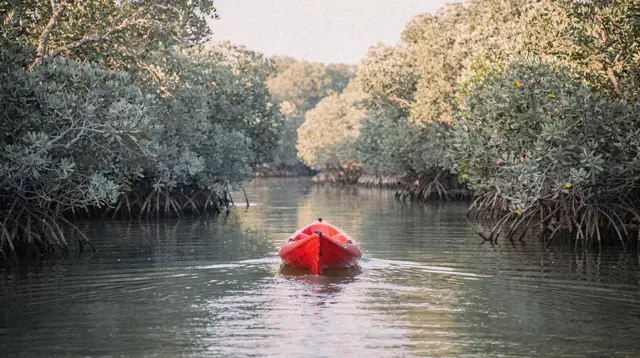
Kayaking around the island — guided kayak tours operate from the resort beach, going around sections of the island’s mangrove coastline. These combine well with mangrove kayaking if you want to compare the two environments; the mangrove kayaking on Sir Bani Yas tends to be more remote and less structured than at Jubail near Abu Dhabi city.
Mountain biking — the island has trail routes through the interior on rented bikes. This is one of the few places in the UAE where off-road cycling through wildlife country is possible. Keep distance from the larger animals.
Archaeological sites — this is one of Sir Bani Yas’s genuinely underrated attractions. The island contains the remains of an early Christian monastery complex dating to the 4th–7th centuries AD — one of the oldest Christian sites in the Gulf. The monastery pre-dates Islam and was occupied by Nestorian Christians who used the island as a monastic retreat. The excavated ruins include a church, cells, and outbuildings. A guide from the resort can take you there; it is not accessible independently.
The monastery’s existence is a reminder that the Gulf was far more connected to early Middle Eastern Christianity than is commonly understood. For visitors with an interest in history, this site alone may justify the trip beyond the wildlife.
Best time to visit
November through March is the optimal window. Temperatures are 20–30°C by day, wildlife is most active, and the island’s planted vegetation looks its best after the slightly cooler months.
April and May are acceptable, with rising heat but fewer visitors. October can be pleasant in the mornings.
Summer (June through September) brings 40–45°C heat. The animals adapt: oryx, gazelle, and other species rest in shade during the midday hours and become active in very early morning or late evening only. The giraffes spend most of the day under tree cover. Safari drives are shifted to pre-dawn and post-sunset windows. The beach, by contrast, is warm and calm in summer — but the wildlife experience is significantly diminished. If beach and snorkelling are your priorities, summer works but is hard going in the heat. If wildlife is the priority, wait for cooler months.
Honest assessment — is Sir Bani Yas worth it?
The answer depends on your priorities and your budget.
If wildlife in the Gulf context is interesting to you — particularly the Arabian oryx as a conservation success story, or the combination of African and Arabian species in an island setting — Sir Bani Yas is unique. Nothing else in the UAE offers this. The desert safari options near Abu Dhabi city deliver dunes and camel riding; Sir Bani Yas delivers genuine wildlife in a managed but not artificial environment. These are very different experiences.
The price is the honest obstacle. A couple spending one night, with flights or a long drive from Abu Dhabi city, ferry crossing, and the resort plus two safari drives, will realistically spend AED 3,000–5,000 (roughly €750–1,250). That is not a casual budget excursion. Day-visit packages reduce the cost but also reduce the quality of the experience significantly — you need the morning drive, which requires the overnight stay.
For families, the island works well: children respond strongly to seeing giraffes from a safari vehicle, and there is no safety concern. The beach and pool keep children occupied between drives.
Compare this with a budget trip built around Abu Dhabi on a budget — Sir Bani Yas does not fit that framework. It belongs to a different category of travel in the emirate.
For a full itinerary that integrates Sir Bani Yas with Abu Dhabi city and inland destinations, the 5-day itinerary includes logistics for the western part of the emirate.
Combining Sir Bani Yas with the rest of the emirate
Because the drive out passes so close to the Al Dhafra region, it makes sense to build a longer western loop rather than a there-and-back trip. Some visitors pair Sir Bani Yas with a night at Liwa and the Empty Quarter for a contrast between island wildlife and pure desert dunes — the two areas are both remote from Abu Dhabi city but very different in character.
Others prefer to break the drive with a stop in Al Ain, the UNESCO-listed “Garden City,” before continuing west. If you are short on time and want a single overnight rather than a multi-stop loop, the resort’s own transfer packages remain the simplest option, and the getting around Abu Dhabi guide has background on renting a car for the drive versus booking a private transfer.
Top-rated tours & activities
Hand-picked tours and activities from GetYourGuide and Viator. Book through these links and we earn a small commission at no extra cost to you.
GetYourGuide does not provide product photos: on its activity cards, the picture illustrates the type of experience and is not the operator's own photo.


Frequently asked questions about Sir Bani Yas wildlife
Do you need to book in advance?
Yes. The resort has limited room capacity and the island controls visitor numbers. Safari drive slots are also limited. Book at least two to four weeks ahead for peak season (November–February). Last-minute availability occasionally exists on weekdays in shoulder months, but do not count on it.
Is the ferry from Jebel Dhanna reliable?
The ferry runs on a schedule tied to resort check-in and check-out times. It is operated specifically for the resort and does not run like a public service. Crossings are cancelled in rough weather, which is uncommon but happens several times per year in winter when Gulf swells increase. The resort provides updates and arranges alternative transport when cancellations occur.
Are the animals behind fences?
The island itself is the enclosure — it is surrounded by water. There are no cages. The animals roam across the island’s 87 square kilometres with minimal physical barriers. Some areas are managed to separate predators (the cheetahs) from prey during breeding seasons, but for the most part the herds move freely. The experience is much closer to a genuine wildlife reserve than a zoo.
Can you see flamingos on Sir Bani Yas?
Yes, particularly along the southern and eastern coastal areas. Greater flamingos use the island year-round but numbers peak in winter. The coastal kayak tours sometimes pass close to flamingo feeding areas.
What is the easiest way to book a visit?
The Anantara website has the clearest package options including ferry transfers from Jebel Dhanna or road transfers from Abu Dhabi city. Third-party tour operators in Abu Dhabi also sell packages that can be compared for price. Be wary of very low-priced options that include the ferry crossing but not the resort accommodation — the day-visit experience is genuinely limited.
Is Sir Bani Yas suitable for elderly visitors or those with limited mobility?
The resort and beach areas are accessible. Safari drives in open vehicles involve some bumping on rough tracks and require the ability to get in and out of a high vehicle — this is manageable for most people but difficult for those with significant mobility limitations. The beach, pool, restaurants, and archaeological site (with a guide) are all accessible. The mountain biking and kayaking require reasonable fitness.
Is there Wi-Fi and mobile coverage?
Mobile coverage exists but is patchy across the island — the resort area has reliable coverage, but the interior and remote beaches do not. Wi-Fi is available in the resort. Most guests find the patchy coverage a feature rather than a problem.
What is the minimum age for safari drives?
Anantara generally accepts children from age six on guided safari drives. Infants and toddlers are not permitted on the open vehicles for safety reasons. Check the current policy when booking as it occasionally changes.
Top-rated tours & activities
Hand-picked tours and activities from GetYourGuide and Viator. Book through these links and we earn a small commission at no extra cost to you.
GetYourGuide does not provide product photos: on its activity cards, the picture illustrates the type of experience and is not the operator's own photo.