
Kayaking Abu Dhabi's mangroves — a practical guide
Can you kayak in Abu Dhabi's mangroves without a tour guide?
Yes. Jubail Mangrove Park rents kayaks directly — no guide required. Expect to pay around AED 60–80 per hour. Guided tours cost AED 150–250 per person and cover a broader route with wildlife commentary.
| At a glance | |
|---|---|
| Where | Jubail Mangrove Park (recommended), Eastern Mangroves, or Mangrove National Park |
| Cost | Self-rental around AED 60–80/hour; guided tours around AED 150–250/person |
| Time needed | 60–150 minutes on the water, plus travel |
| Getting there | 15 min from downtown (Eastern Mangroves) or around 30 min (Jubail), no public transport to Jubail |
| Best time | November–March, early morning for wildlife and cooler temperatures |
Why Abu Dhabi has one of the Gulf’s largest mangrove forests
Abu Dhabi’s mangroves are not a coincidence. The emirate sits at the convergence of shallow tidal flats, warm brackish water, and low-wave coastlines — exactly the conditions that allow Avicennia marina, the grey mangrove, to thrive. The UAE as a whole holds around 50 percent of all mangroves on the Arabian Peninsula, and Abu Dhabi accounts for most of that coverage.
The emirate has also invested heavily in conservation and replanting since the 1970s. Sheikh Zayed, the UAE’s founding president, was an early conservationist who understood the ecological function of the mangroves: they stabilise coastlines, filter water, provide nursery habitat for fish, and support a remarkable number of bird species for a desert country. Today, the Mangrove National Park is a protected area covering around 19 square kilometres, and Jubail Island’s mangrove zone is the largest continuous mangrove forest in the UAE.
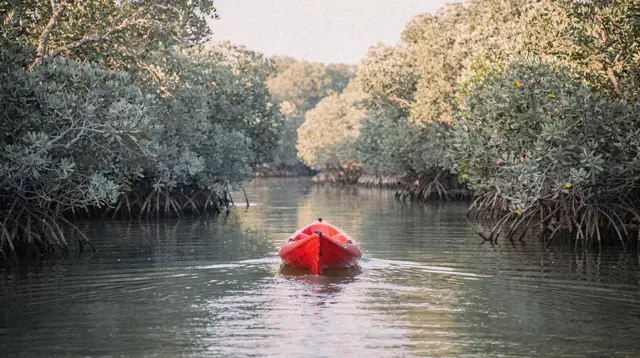
For visitors, this means access to a genuinely unusual natural experience — paddling through salt-water channels fringed with chest-high roots, watching herons fish a metre from your kayak, completely at odds with the concrete skyline visible just above the treetops. It is one of the most distinctive nature activities in the region, and unlike much of what Abu Dhabi sells to tourists, it costs relatively little and requires no luxury booking.
The three main kayaking locations
Eastern Mangroves — closest to downtown
The Eastern Mangroves area runs along the northeastern edge of Abu Dhabi island, roughly behind the Eastern Mangroves Hotel and Spa. This is the most accessible spot from central Abu Dhabi — a 15-minute drive from the Corniche — and several kayak and paddleboard operators are based at or near the hotel.
The waterway here is calm, protected, and navigable even for complete beginners. Channels wind between mangrove stands, and on a weekday morning it is quiet enough that you will hear birds over the sound of distant traffic. The tradeoff is that this is also the most built-up section of Abu Dhabi’s mangroves — the hotel, nearby apartment towers, and the highway are visible throughout, which breaks the sense of wilderness somewhat.
For getting around Abu Dhabi easily, this location is the best choice: taxis and Careem reach it directly, and there is parking if you are driving yourself.
Jubail Mangrove Park — the recommended first choice
Jubail Mangrove Park, officially part of Jubail Island, opened in 2021 and has become the go-to mangrove destination for residents and well-informed visitors. It is about 30 minutes from downtown Abu Dhabi by car (no public transport), and it offers something the Eastern Mangroves cannot: a proper nature park experience with facilities designed around the environment rather than around a hotel.
The park has a 2.5km elevated boardwalk that winds through the mangrove forest at canopy height — this is worth doing even if you are not kayaking. From the boardwalk you can spot birds, watch the tidal flow, and see the aerial root systems clearly. Entry to the boardwalk is free. Kayak rentals are available onsite, typically from AED 60–80 per hour for a single kayak. Opening hours are generally 8:00 am to 6:00 pm (Saturday through Thursday) and until 7:00 pm on Fridays, but check before visiting as seasonal adjustments apply.
Parking is free and well-organised. There are bathrooms, drinking water stations, and a small café at the main entrance. The park is run with clear rules about staying in designated channels and not touching the vegetation — guides (or signage) make these clear.
The kayaking channels at Jubail are longer and more varied than the Eastern Mangroves. You can paddle for 60–90 minutes without retracing your route, and the forest is denser, which means better wildlife sightings. This is where most serious birdwatchers and photographers go.
GetYourGuideAbu Dhabi: Mangrove Kayak Tour with Hotel Pickup Drop OffCheck availability →Mangrove National Park — remote, for the committed
The Mangrove National Park, designated in 2013, covers a larger area further from the city and requires more planning. There are no facilities in the way Jubail has them, and access typically requires joining a guided tour or arranging boat-based access. Independent kayaking here is not impossible, but the logistics make it less practical for most visitors.
If you are spending multiple days in Abu Dhabi and want to see the most pristine section of mangroves without any urban backdrop, this is worth researching through tour operators. But for a first visit, Jubail does the job better with far less friction.
Guided tours vs renting your own kayak
Both options work, and the right choice depends on what you want.
Guided tours (AED 150–250 per person for a two-hour session) include a kayak, paddle, life jacket, and a guide who knows the channels and the wildlife. The guide will point out species, explain the ecology, and manage the group’s pace. For first-time paddlers, nervous beginners, or anyone who wants to learn something rather than just move around the water, a guided tour is the better value despite the higher price. Groups are typically capped at 8–12 people.
GetYourGuideAbu Dhabi: 2 Hour Guided Kayak Tour in the MangrovesCheck availability →Self-rental at Jubail (AED 60–80 per hour) suits people who are comfortable on the water, want to set their own pace, and would rather explore quietly than follow a group. You get a basic safety briefing and a map of the permitted channels. You will not get wildlife commentary, but you will have far more flexibility to pause, drift, and watch. Bring your own binoculars.
One thing worth noting: some kayak rental companies operating at the Eastern Mangroves run with aging equipment — kayaks with worn seats, paddles that flex more than they should, and spray skirts that do not seal well. At Jubail, the park-run rentals are generally in better condition because the facility is newer. If you book through a private operator at Eastern Mangroves, look at the equipment before you pay.
What you will actually see on the water
The star wildlife sightings at Abu Dhabi’s mangroves are birds. Grey herons are common year-round — these large, slow-moving birds often stand in the shallows within a few metres of kayakers who approach quietly. Western reef herons (in both grey and white colour morphs) are equally common.
Greater flamingos visit seasonally, primarily between October and March. They feed in the shallow mudflats at low tide, often in groups of dozens. Sightings are not guaranteed — they move with tidal patterns and can disappear for days — but when they are present, they are unmissable.
Other regular sightings include cormorants, ospreys, kingfishers, and various waders. During spring and autumn migration (September–October and March–April), rarities turn up. The mangroves are listed as an Important Bird Area under international classification.
Below the water: mullet are extremely common and leap frequently near kayaks. Fiddler crabs work the exposed mudflats at low tide — small, orange-clawed, and present in hundreds at the right state of tide. Occasionally, green turtles pass through the channels, though sightings are not reliable.
What you will not see: there are no crocodiles, no dangerous animals, and no species that create any safety concern. The mangroves are a safe environment.
The best time to go — and the summer reality
The ideal window is November through March. Water temperatures are comfortable, air temperatures are manageable (18–30°C), and wildlife activity is highest during the cooler months. Sunrise and the first two hours of morning are the best time for birdwatching — herons are feeding, the light is low and golden, and the channels are quiet before tour groups arrive.
Summer (June through September) is brutal. Air temperatures reach 40–45°C by 9:00 am, and humidity near the water makes it feel worse. Most guided tour operators either suspend services entirely from July to August or shift to pre-dawn departures (5:30–7:30 am). If you are visiting Abu Dhabi in summer and want to kayak, book the earliest possible morning slot — not because the kayaking will be comfortable, but because it will be survivable. Midday kayaking in summer is inadvisable for health reasons.
April, May, and October sit in between: hot but not catastrophic, and tours run normally. Early mornings in October can be genuinely pleasant.
What to bring
Regardless of whether you are self-renting or joining a tour, bring the following:
- Water, more than you think (at least one litre per hour in warm months)
- High-SPF sunscreen applied before you arrive — reapplication on the water is difficult
- A hat with a full brim or a cap that covers the neck; sun exposure on the water is intense
- Sunglasses
- A change of clothes sealed in a waterproof bag — you will get wet, particularly when entering and exiting the kayak at low-water landings
- Closed-toe shoes you do not mind soaking, or sandals with a strap at the heel (bare feet in a kayak are uncomfortable on longer paddles)
- Insect repellent for dawn and dusk sessions (mosquitoes are present near the mangroves — not in dramatic numbers, but enough to be worth addressing)
- A dry bag for your phone if you plan to take photographs from the kayak
Leave heavy items in the car. Bags and cameras that cannot get wet create problems in small kayaks.
Fitness level and paddling difficulty
Abu Dhabi’s mangrove channels are sheltered, tidal, and almost entirely flat-water. There is no current to fight, no surf to navigate, and the wind that reaches into the channels is minimal. If you have ever paddled a kayak at a lake or river, you will find this straightforward.
For complete beginners: the seated, single-blade paddling style used in sit-on-top kayaks (the most common rental type here) can be picked up in 10 minutes of instruction. Arms and shoulders will ache on longer sessions if you are not used to it, so an 80-minute tour is genuinely sufficient for most first-timers. Do not book a three-hour independent rental if you have never kayaked before.
For children: children from around age six or seven can sit in a tandem kayak (two-person) with a parent. Solo kayaks for children are available at some operators for kids above about age ten. Most guided tours specify minimum age requirements — typically eight to ten years old.
Wheelchair access: the Jubail Mangrove Park boardwalk is wheelchair accessible for the full 2.5km. Kayaking is not accessible in the standard rental format, but this is worth checking with individual operators as adaptive equipment occasionally exists.
Combining mangrove kayaking with other activities
The Eastern Mangroves area pairs naturally with lunch at the Eastern Mangroves Hotel, which has a waterfront terrace with views over the channel you have just paddled through. It is priced at the higher end (AED 80–150 per person for mains), but the location is good for a post-paddle meal.
Jubail Mangrove Park is further from central Abu Dhabi’s restaurants, but the drive back to the city takes you past areas of Yas Island if you want to combine a nature morning with an afternoon at Abu Dhabi’s beaches.
For visitors interested in broader nature experiences, kayaking at the mangroves pairs well with a desert safari on a different day — the contrast between these two ecosystems within the same emirate is one of Abu Dhabi’s genuine surprises. You can also connect the nature theme across the emirate by visiting Sir Bani Yas wildlife reserve for a very different kind of wildlife encounter, or exploring the Liwa and the Empty Quarter for the desert equivalent.
If you are building a full nature-focused itinerary, the 5-day Abu Dhabi, Al Ain and desert itinerary includes suggestions for integrating water-based and inland activities without backtracking.
Environmental rules — and why they matter
The mangroves are a protected ecosystem and the rules exist because they are fragile. Key restrictions:
- Do not stand on, push against, or grab mangrove roots. The root systems are the infrastructure of the whole ecosystem — they anchor the trees, oxygenate the soil, and provide habitat for fish and crabs. Snapping a root with a kayak paddle or by standing on it causes damage that takes years to recover.
- Stay in the designated channels. Some areas are roped off for tidal restoration or wildlife protection. These boundaries are not bureaucratic box-ticking — flamingo feeding grounds and nesting areas are deliberately excluded from public access.
- Do not feed the fish or birds. This is posted at Jubail and enforced by rangers during busy periods.
- Take all rubbish with you. The fine for littering in protected areas is AED 1,000.
Tour guides enforce these rules, which is another argument in favour of guided tours for visitors who are unfamiliar with the environment.
For more context on Abu Dhabi’s conservation efforts and responsible tourism, see the sustainable Abu Dhabi guide.
Top-rated tours & activities
Hand-picked tours and activities from GetYourGuide and Viator. Book through these links and we earn a small commission at no extra cost to you.
GetYourGuide does not provide product photos: on its activity cards, the picture illustrates the type of experience and is not the operator's own photo.


Frequently asked questions about mangrove kayaking in Abu Dhabi
Do I need to book in advance or can I just show up?
At Jubail Mangrove Park, walk-in kayak rentals are usually available on weekdays, but weekend mornings (Friday and Saturday in the UAE) fill quickly, particularly from October to March. Guided tours from external operators should be booked at least 24 hours ahead, and popular tours during peak season (December–January) may need several days’ notice. The park’s own rental operation does not take advance reservations — it is first-come, first-served.
Is it safe to kayak alone without a guide?
Yes, for experienced paddlers. The channels are sheltered and there are no hazards beyond the occasional motorboat wake in the wider waterways near the entrance. Tell someone where you are going, carry your phone in a dry bag, and stay within the designated areas. The park has rangers on the water who check on solo paddlers.
What is the water visibility like — can you see the bottom?
Water clarity depends on tidal conditions and time of day. At high tide over sandy bottom areas, visibility can be 1–2 metres. In the channels between dense mangrove stands, the water is often darker (tannin-stained from the leaves) and visibility drops to under half a metre. You will see fish jumping and wading birds fishing rather than viewing underwater life directly.
Are there mosquitoes?
Yes, particularly at dawn and dusk from October to May when the weather is cooler. Midday mosquito activity is minimal. Bring insect repellent for any early morning session. Summer mosquito populations drop because the heat limits their range, but early morning summer tours still see some activity near the water.
Can you swim in the mangroves?
Swimming is not permitted in the designated kayaking channels, and it is not particularly pleasant in practice — the water is shallow, the bottom is soft mud, and visibility is low. The activity is paddling, not swimming. If you want a swim, Abu Dhabi’s beaches are the right destination.
How long does a kayaking session take?
A guided tour runs 2–2.5 hours including briefing, launching, the paddling circuit, and return. For self-rental, most people paddle for 60–90 minutes before their arms have had enough if they are not regular paddlers. The Jubail boardwalk walk (without kayaking) takes about 45 minutes at a relaxed pace.
Is the kayaking suitable for young children?
Most operators accept children from age eight in tandem kayaks with a parent. Younger children (four to seven) can sometimes come in a tandem if they are comfortable in water and the weather is calm — check with the specific operator before booking. The boardwalk at Jubail is a good alternative for families with very young children who cannot kayak.
What does it cost for a family of four?
At Jubail self-rental: roughly AED 240–320 for two tandem kayaks for 90 minutes. On a guided tour: AED 600–1,000 for four people depending on the operator and tour length. The boardwalk is free. Budget AED 300–400 for the day for a family including transport, kayak rental, and snacks.
Top-rated tours & activities
Hand-picked tours and activities from GetYourGuide and Viator. Book through these links and we earn a small commission at no extra cost to you.
GetYourGuide does not provide product photos: on its activity cards, the picture illustrates the type of experience and is not the operator's own photo.