
Sustainable travel in Abu Dhabi: what's real, what's greenwashing
Sustainable travel in a city built on oil
Abu Dhabi sits on one of the largest oil and gas reserves on earth. The economy that built the Grand Mosque, the Louvre, and the Yas Island theme parks runs substantially on hydrocarbons. Any honest guide to sustainable travel here has to acknowledge this upfront: there are real contradictions between “eco-tourism in Abu Dhabi” and the broader reality of what the city is and how it came to exist.
That said, the city has made genuine investments in specific areas of sustainability — renewable energy, nature conservation, and public transport — that matter to travellers who want to make lower-impact choices. This guide separates the genuine from the cosmetic, and gives you practical options for a visit that sits lighter on the city’s natural environment.
| Where | Masdar City (edge of Abu Dhabi city), Eastern Mangrove National Park, Sir Bani Yas Island (around 240 km / a half-day trip with ferry) |
| Cost | Mangrove kayaking around 150–250 AED (40–70 USD); Sir Bani Yas day trip or overnight varies with ferry and lodging choice; Hafilat bus fares a few AED |
| Time needed | A half-day for mangrove kayaking or Masdar City; a full day or overnight for Sir Bani Yas |
| Getting there | Taxi, ride-app, or Hafilat bus within the city; ferry or short flight from Jebel Dhanna to Sir Bani Yas |
| Best time | Around November to March, for comfortable kayaking, walking, and outdoor wildlife viewing |
What Abu Dhabi is genuinely doing
Masdar City and renewable energy
Masdar City, on the outskirts of Abu Dhabi, was envisioned as the world’s first zero-carbon city. It hasn’t become that — construction has proceeded much more slowly than originally planned, and the ambitions were scaled back significantly. What exists is a small, functioning urban district powered by solar energy, home to research institutions and a few international companies.
Masdar City is open to visitors (access via the Masdar Institute of Science and Technology and guided tours). It’s interesting as an experiment in urban design — car-free streets, solar panels on most surfaces, a personal rapid transit system — even if the original vision wasn’t realised. It’s worth visiting if you’re genuinely curious about sustainable urban planning; less compelling as a tourist attraction in isolation.
Abu Dhabi also hosts the International Renewable Energy Agency (IRENA) headquarters, and Masdar (the Abu Dhabi Future Energy Company) is a significant international investor in solar and wind projects globally. These are real, not cosmetic, contributions to the energy transition — even as the emirate continues to develop its oil reserves simultaneously.
Nature conservation areas
The UAE has a genuinely strong record on certain wildlife conservation efforts. Sir Bani Yas Island — a wildlife reserve island about 240 km from Abu Dhabi city — was established by Sheikh Zayed as a conservation area in 1977 and has been operating as such since. It hosts populations of Arabian oryx, cheetahs, giraffes, and over 10,000 other animals. Access is via ferry from Jebel Dhanna or by air. See our Sir Bani Yas wildlife guide for details.
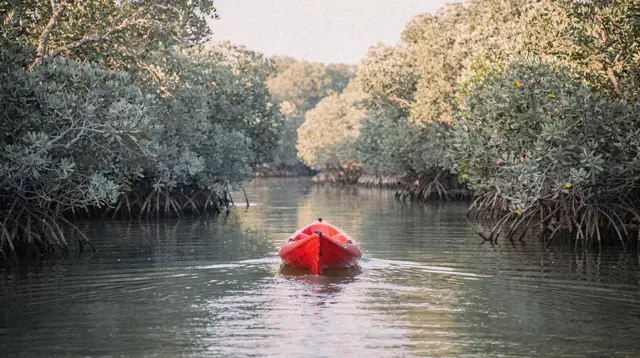
The Eastern Mangrove National Park protects a significant belt of mangrove forest along the eastern coast of Abu Dhabi island. Mangroves are critical ecosystems — they sequester carbon at rates much higher than tropical forests, filter water, and provide habitat for hundreds of species. Mangrove kayaking here is a genuinely meaningful nature experience, not a greenwashed tour. The ecosystem is real, the conservation is active, and the kayaking tours — run by licensed operators — are low-impact by nature.
Public transport investment
Abu Dhabi has been investing in public transport, including bus rapid transit corridors. The Hafilat bus network is functional and used by residents. Ferries operate between parts of the coastline. However, the city remains fundamentally car-dependent — distances are large, temperatures make walking impractical for much of the year, and cycling infrastructure is limited to specific recreational routes (the Corniche cycle path, Yas Island cycling tracks).
ViatorAbu Dhabi City Tour in a 4x4 Shared Vehiclefrom €79Check availability →Comparing the lower-impact options
Not every “green” option in Abu Dhabi delivers the same benefit. This is a rough comparison of the choices covered below, ranked by genuine environmental value versus convenience:
| Choice | Environmental value | Convenience | Notes |
|---|---|---|---|
| Mangrove kayaking | High — zero-emission, protected ecosystem | Medium — booking + morning slots fill up | The single best low-impact activity in the city |
| Sir Bani Yas safari | High — active conservation reserve | Low — ferry/flight, day trip or overnight | Genuine, but the travel footprint to reach it is real |
| Hafilat buses | Medium — shared transport, low emissions per rider | Low — limited routes to tourist sites | Works for city-centre trips, not for Yas Island or the mosque |
| Dhow cruise | Low-medium — motorised but shared | High — widely available, easy to book | Better than solo motorboat rental, not carbon-neutral |
| ”Eco” desert safari | Low, usually — same 4x4 convoy as standard tours | High | Ask about certification before assuming it’s different from a standard tour |
| Masdar City tour | Symbolic — interesting design, limited real-world scale | Medium — requires a booked tour | Worth it for curiosity, not as proof of citywide sustainability |
Water use and the desert reality
It’s worth naming a less-discussed issue: Abu Dhabi’s water supply relies heavily on energy-intensive desalination, and the city’s famously green golf courses, parks, and hotel landscaping consume large volumes of desalinated or treated water in a place with essentially no natural fresh water source.
Some newer developments (Masdar City among them) use treated wastewater for irrigation, which is a genuine improvement, but the underlying model — extensive lawns and golf courses in the middle of a desert — remains resource-intensive regardless of the irrigation source. If minimising your water footprint matters to you, favour hotels that state their water-recycling practices explicitly rather than assuming a “green” appearance means low water use.
Lower-impact travel choices for visitors
Get on the water sustainably
Mangrove kayaking is the most genuinely eco-positive activity available. Tours run out of the Eastern Mangrove area and use paddle kayaks or stand-up paddleboards — zero-emission, low-impact, and the ecosystem you’re paddling through is actively protected. Cost is typically 150–250 AED (40–70 USD) for a guided two-hour tour. Morning tours avoid the heat (in cooler months) and offer best wildlife viewing.
Dhow cruises use motorised boats, so they’re not carbon-neutral, but they’re a lower-impact way to see the coastline than private motorboat rental, and they support local maritime heritage.
ViatorSandventuresfrom €84Check availability →Wildlife experiences with integrity
The Sir Bani Yas wildlife experience operates under a genuine conservation framework. Visitors on guided safari drives see animals in a large reserve rather than a zoo setting, and the fees contribute directly to the reserve’s operation. It requires a day trip or overnight stay (the island has an Anantara resort and a small lodge), which means a ferry crossing or flight — factor this into your emissions calculation if that matters to you.
Reduce taxi dependency
Using Hafilat buses is slower but cheaper and lower-impact than taxis or private cars. The bus app shows routes and real-time arrivals. For the Corniche to Khalidiyah area, buses run frequently. For the Grand Mosque and airport, less so. If you’re staying in the city centre, walking on the Corniche is genuinely pleasant in cooler months.
For the Al Ain day trip, the intercity bus from Abu Dhabi (CAFU bus network) runs regularly and takes around 90 minutes — cheaper than a private taxi and a lower-impact way to cover the distance.
Food choices
Abu Dhabi’s food system is heavily import-dependent — the climate makes local agriculture very limited. That said, there are a few meaningful choices: local fish and seafood (hammour, kingfish, shrimp from Gulf waters) has a lower carbon footprint than imported beef. Date products are genuinely local and significant culturally. Some hotel restaurants and the Emirati food scene source ingredients regionally. Avoiding hotel buffets — which have high food waste — in favour of ordering from menus is a small but real choice.
Hotels with genuine sustainability credentials
Several hotels in Abu Dhabi have pursued LEED certification or similar standards. The Rosewood Abu Dhabi and certain Marriott properties have published sustainability commitments. These range from meaningful (solar water heating, water recycling, reduced single-use plastics) to cosmetic (towel reuse programmes with no other changes). Review the specific hotel’s sustainability page rather than relying on branded claims.
What to be sceptical about
“Eco-tour” labelling: Several tour operators describe standard desert safaris or boat trips as “eco” without any substantive environmental practices. Ask operators whether they hold any certification from the Emirates Wildlife Society, operate in protected areas, or have a stated no-impact policy for their activities.
Offsetting claims: Some hotels and operators offer carbon offsetting as an add-on. The quality of carbon offset projects varies enormously. If offsetting matters to you, use an independent offset provider and be sceptical of vague “we plant trees” claims.
Masdar City as a destination: It’s interesting as an urban experiment but shouldn’t be visited primarily as proof of Abu Dhabi’s green credentials. The story is more complicated than that.
Practical notes
The Founders’ Memorial is free to enter and celebrates Sheikh Zayed’s environmental legacy — he was a genuine conservationist who established the Houbara Bustard Protection Programme and Sir Bani Yas Island as a reserve decades before sustainability became a marketing term. It’s worth visiting on its own terms.
Nature-focused tours from responsible operators, wildlife at Sir Bani Yas, and awareness of the Emirati culture that includes deep traditional connections to the land are the most authentic points of contact with Abu Dhabi’s genuine environmental story.
Top-rated tours & activities
Hand-picked tours and activities from GetYourGuide and Viator. Book through these links and we earn a small commission at no extra cost to you.
GetYourGuide does not provide product photos: on its activity cards, the picture illustrates the type of experience and is not the operator's own photo.


Frequently asked questions about sustainable travel in Abu Dhabi
Is it possible to travel sustainably in Abu Dhabi?
Partially. You can make lower-impact choices — public transport where available, kayaking over motorboat tours, local fish over imported beef, conservation-area wildlife experiences. But Abu Dhabi is a car-dependent, high-consumption city in a hot desert, and the fundamental infrastructure isn’t built around low-impact tourism. Honest expectations matter.
What is Masdar City and is it worth visiting?
Masdar City is a partially-built sustainable urban district in Abu Dhabi, powered by solar energy and car-free within its boundaries. It’s interesting as an experiment in urban design and can be visited on guided tours. It has not achieved its original goal of being the world’s first carbon-neutral city, and visitors expecting a complete city will find a small, quiet district.
What is the best nature experience in Abu Dhabi?
Mangrove kayaking in the Eastern Mangrove National Park and a wildlife safari on Sir Bani Yas Island are the two strongest options. Both involve genuine ecosystems with active conservation, rather than curated tourist performances.
Does Abu Dhabi have good public transport?
For specific corridors — central city bus routes — Hafilat buses work reasonably well. For tourist attractions, particularly the Grand Mosque, Saadiyat, and Yas Island, public transport connections are limited and taxis or ride apps are more practical. The city is working on improving connections, but it remains primarily car-dependent.
What is Abu Dhabi doing on renewable energy?
The Abu Dhabi National Energy Company (TAQA) and Masdar are both substantial investors in renewable energy globally. Within the UAE, solar power projects have expanded significantly, and some of the world’s largest solar plants operate in the region. The city also continues to produce and export oil — these activities coexist, which is the honest picture.
Is Sir Bani Yas worth the extra travel time for sustainability-minded visitors?
Yes, if you have a full day or can stay overnight. It’s the closest thing Abu Dhabi has to a genuine wildlife conservation experience — a reserve established in 1977, not a recently-built attraction — and the ferry crossing is a lower-impact way to reach it than a private charter. See the Sir Bani Yas destination guide for logistics.
Does staying fewer days reduce my footprint more than choosing eco activities?
To some extent — fewer flights and shorter stays generally have the largest single impact on any trip’s footprint, sustainability activities aside. If you’re planning your visit length, see how many days in Abu Dhabi makes sense for what you actually want to see, rather than padding the trip unnecessarily.
Top-rated tours & activities
Hand-picked tours and activities from GetYourGuide and Viator. Book through these links and we earn a small commission at no extra cost to you.


